The Five Dimension System
Most self-defense programs start with technique, the wrong place to start. A framework built for how executives actually live begins somewhere else.

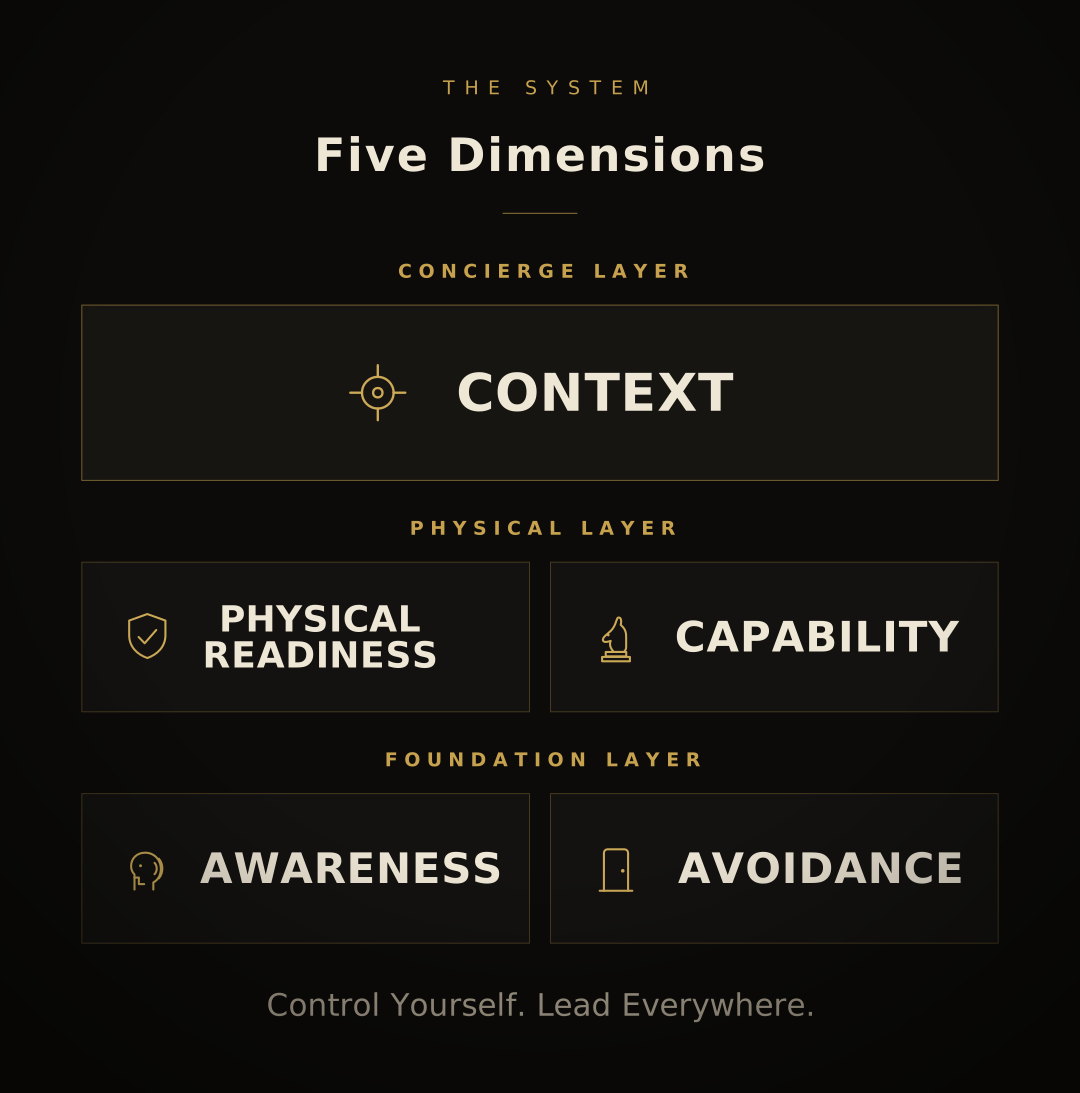
Most self-defense programs are built around a catalog of techniques. They teach what to do when someone grabs your wrist, what to do when someone pushes you, what to do in a sequence of specific, cooperative, choreographed scenarios. In a controlled environment, against a compliant partner who knows the script, these techniques look effective. Under real conditions: stress, speed, an uncooperative opponent, an environment that does not resemble the gym, they frequently are not.
This is not a criticism of any particular program. It is a structural observation about the difference between techniques and principles.
Techniques depend on conditions remaining predictable. When a situation unfolds the way the technique was designed for, the technique works. When it doesn’t: different grip, different angle, different size differential, a second person entering the situation, the technique has no answer. The person who has only techniques is left searching their catalog for a match that does not exist.
Principles hold when conditions change. They are the underlying logic beneath all technique. When you understand the principle: why a position is dominant, what distance creates which options, why control precedes force, you can adapt when the situation is not the one you practiced. The person who has principles can reason under pressure. The person who only has techniques cannot.
The Five Dimension System is built around principles, not technique catalogs. It is designed for executives: people with demanding schedules, significant physical responsibilities, and no interest in becoming fighters. The goal is not peak performance. The goal is genuine capability: the kind that holds when the situation is real and unscripted.
The Five Dimensions
Awareness
Awareness is the first dimension and the highest-return investment in the system. It is also the most misunderstood.
Most people treat awareness as a binary state: alert or not alert. Neither setting is functional at scale. Constant hypervigilance is exhausting and unsustainable. Complete inattention is exposure. Calibrated awareness: the trained ability to read an environment accurately, at a level of attention that is sustainable across an executive’s actual life, is something different from both.
Awareness is the ability to surface what matters and filter what does not. It is pattern recognition: the difference between a person who is agitated and a person who is preparing. The behavioral cues that precede escalation: target glance, interview behavior, positioning, are learnable. They are not intuition. They are observable signals that can be trained as habits and applied in every environment the executive moves through.
The executive who has developed genuine awareness rarely needs the dimensions that follow. Most situations are resolved at the awareness level: early recognition of a developing situation creates options: route change, early exit, repositioning, that are no longer available once contact is imminent. Awareness does not just reduce danger. It multiplies options.
Avoidance
If awareness is reading the situation accurately, avoidance is acting on that read before the situation reaches contact. The best outcome of any physical confrontation is the one that never happens.
This is not a platitude. Every confrontation carries consequences for an executive that extend beyond the physical: legal, financial, professional, reputational. An executive involved in a public physical incident faces potential outcomes that a title and a career cannot absorb cleanly, regardless of who was in the right. Avoidance is not weakness. It is the highest-leverage move available.
Avoidance encompasses verbal de-escalation: not the theoretical version, but the specific verbal and non-verbal patterns that reduce the probability of a situation reaching contact. It encompasses environment management: where to position in a restaurant, how to enter and exit a parking structure, how to move through a hotel with high-visibility profile. It includes the decision window: the moment when leaving is still an option, and the trained ability to recognize and move through that window before it closes.
The executive who has internalized avoidance has practiced the exit before the situation requires it. That rehearsal is what makes the exit available under stress.
Physical Readiness
Technique requires a platform. An executive who is significantly deconditioned cannot execute even sound technique under real stress. The body fails before the mind does. Adrenaline degrades fine motor function, elevates heart rate past the threshold of clear decision-making, and taxes a cardiovascular system that may not have reserve capacity.
Physical readiness for executive self-defense is not about high performance. It is about sufficiency: enough grip strength to manage a non-compliant person, enough cardiovascular capacity to function clearly under stress, enough functional mobility to manage body weight on the ground, enough conditioning to execute any of the preceding for longer than a few seconds.
The specific attributes that matter in a real encounter are not the ones most people train for. Marathon endurance is not the constraint. Powerlifting maxes are not the constraint. The ability to stay functional: physically and cognitively, through a short, violent, high-adrenaline encounter, that is the constraint. Training to that standard is both more achievable and more practically relevant than the alternatives.
Physical readiness also has to fit an executive’s life. Travel, irregular hours, time pressure, and the injury constraint: the executive cannot afford to be sidelined, all shape what a sustainable protocol looks like. The minimum effective dose, consistently executed, outperforms the ideal program that gets abandoned during the next demanding quarter.
Capability
Capability is where technique lives in the system: but technique built on the preceding three dimensions, not before them. This sequencing is not arbitrary. It is the logic of what holds under real conditions.
The governing principle of physical confrontation is distance. Distance determines what options exist for both parties. Managing distance proactively: not reactively, is the meta-skill that makes everything else more effective. The executive who controls distance controls the encounter. The one who cedes it is reacting to an opponent’s choices rather than making their own.
Within contact range, control precedes force. The executive context is specific here: a controlled opponent is a managed situation. An opponent who has been struck is an unpredictable situation with legal and physical escalation risk that the executive cannot fully anticipate or absorb. Grappling and control-based approaches: the same principles that govern Brazilian jiu-jitsu, are the appropriate tool not because they are elegant, but because control is more accurate and more defensible than force in the environments executives actually operate in.
Most physical confrontations go to the ground or clinch within seconds of contact. The executive who has never been on the ground under a larger, non-compliant opponent carries a specific vulnerability that standing technique cannot address. That vulnerability is not primarily physical. It is psychological: the shock of being taken to the ground, the disorientation of an unfamiliar position, the cognitive interruption that precedes any technical response. Building minimum ground competency closes that vulnerability.
Context
The first four dimensions are universal. Context is where the system becomes specific to the individual executive.
Context is the personal architecture of the executive’s actual risk profile: the environments they move through, the responsibilities they carry, the public profile they maintain, the jurisdictions they travel through, the pre-built decision framework that governs their use of force. Without context, the system is a template. With it, it is a personal protection architecture calibrated to the executive’s actual life.
The executive who travels internationally three weeks per month has a different context than one who is primarily domestic. The executive with significant public visibility has a different context than one with a low profile. The executive with young children in public environments faces different protective responsibilities than one without. Context does not change the principles of the preceding dimensions: it shapes how those principles are applied, weighted, and practiced.
Why the Sequence Matters
The Five Dimensions are presented in a specific order because that order reflects how real situations develop and how real capability accumulates.
Awareness reduces the probability that a situation becomes dangerous. Avoidance resolves situations that awareness has identified. Physical Readiness ensures the platform exists to execute everything else when it is needed. Capability provides the principled technique that holds when a situation reaches contact. Context ensures that all of the preceding is calibrated to the executive’s actual life and responsibilities.
The executive who starts with Capability: the most common instinct, because technique feels concrete and actionable, has skipped the dimensions that determine whether technique is ever needed and whether it will hold when it is. Technique without the preceding three dimensions is capability on an unstable foundation. It works under controlled conditions and fails under real ones, precisely when it matters most.
What This Looks Like in Practice
The Five Dimensions system is how Frassetti teaches across all contexts, including the kids’ classes he teaches when his schedule permits at the academy.
After one such class, a father approached him. The interaction was brief: they were not particularly close, and Frassetti was uncertain what had prompted it. The father explained that his son had encountered a group of bullies at school in a situation that could have turned dangerous. What the boy did was not fight. He recognized the situation developing before it escalated, used what he had been taught about de-escalation, and exited cleanly. No harm to anyone. No physical confrontation.
The father’s point was direct: if his son had only been taught how to fight, the outcome would have been different. Having a framework: the ability to read what was developing, respond before it became physical, and move through the situation without contact, was what made the difference. And that framework had been available because it had been taught as a system, not as a set of techniques to deploy when contact was already happening.
The principle that applied to a child in a school hallway is the same principle that applies to an executive in a hotel corridor. Earlier intervention is always the better outcome. The system is built to make earlier intervention possible.