Built from first principles.
For the life you actually lead.
Every private training engagement is built on the same framework: five dimensions of real-world capability, developed in sequence, calibrated entirely to your context.
You already know the gap is there.
You carry responsibility for people who depend on you. You travel, move through unfamiliar cities, and operate in environments where your visibility is real. Somewhere underneath the schedule and the obligations is a quiet awareness that the gap between who you are professionally and how prepared you are physically, for the moments that actually matter, is larger than it should be.
Most self-defense programs don't close that gap. They fill it temporarily with a weekend seminar or a technique collection, and leave you with the feeling of something missing. The techniques don't hold under real stress, against real resistance, in conditions you can't control.
The reason is not effort. The reason is structure.
First principles, not a catalog.
A first-principles approach starts with the handful of absolute truths that govern physical confrontation: positional hierarchy, structure and base, control before force, the relationship between distance and danger. These are not fighting techniques. They are the governing logic beneath all of them.
When you understand the principle, the technique becomes an application of something you already know, not a new memorization. You learn faster. You retain it under pressure. You adapt when the situation doesn't match the scenario you practiced. That adaptability is exactly what techniques alone cannot give you, and exactly what real scenarios require.
The framework in full.
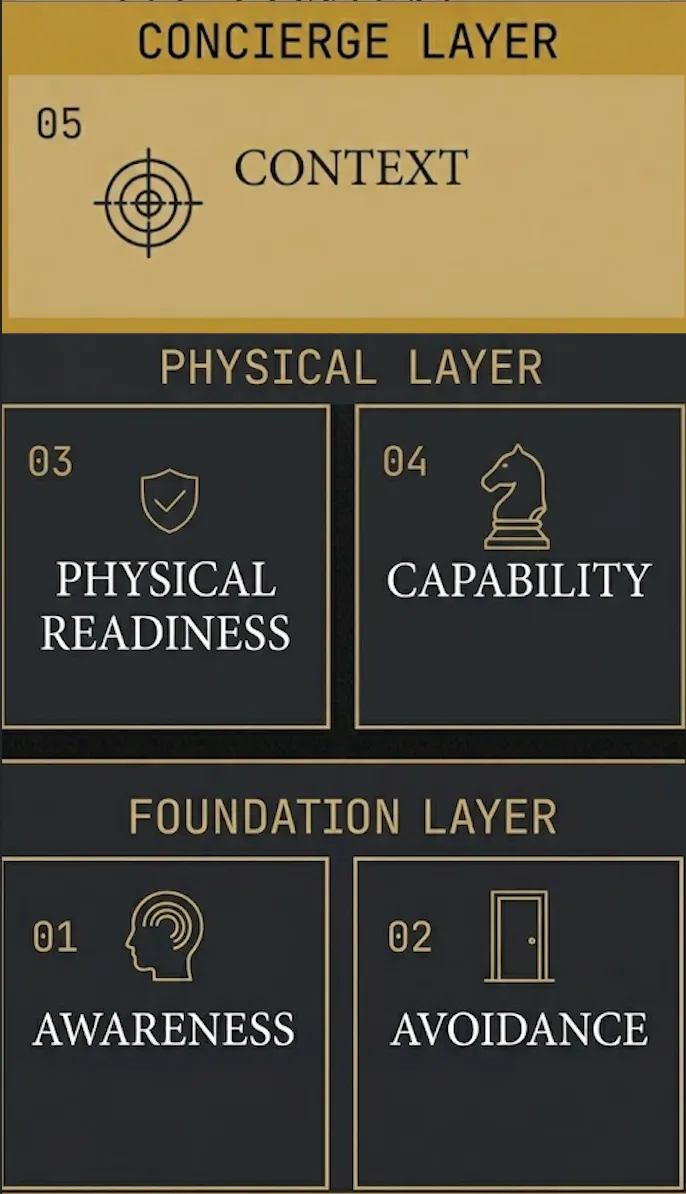
Five dimensions of capability, developed in sequence. The first two are foundational: the habits of mind and environment that resolve most situations before contact. The next two are physical: building physical capability and technical readiness. The fifth is the concierge layer: the calibration of everything to your specific lifestyle, your risk profile, and the people you protect.
Reading environments and people.
Most adverse situations have early indicators that a trained observer reads and responds to before they develop. Most people miss them, not because the signals aren't there, because they have never been taught to look or are too distracted. Awareness training installs those perceptual habits: how to read a space, how to identify behavioral pre-indicators, how to maintain situational awareness in high-distraction environments without impairment.
Equally important is discrimination: the ability to ignore noise. Awareness that produces anxiety about every ambiguous situation is not capability. Both sides are developed together.
Practiced exits before contact.
The best outcome is the one that never escalates. Verbal de-escalation, environment management, and decisive movement before a confrontation crystallizes are taught as practiced patterns. An executive who has rehearsed specific exit sequences and verbal responses does not have to improvise. The pattern runs. That is the difference.
Conditioning that fits your life.
Physical capability matters and is developed alongside the other dimensions, not as a prerequisite. The protocol is built around your actual schedule, not an aspirational plan that collapses the moment a quarter-end push or a family obligation arrives. The standard is not elite performance. The standard is being physically capable of protecting your loved ones and maintaining that capability across years, not weeks.
Technique that holds under pressure.
This is where most self-defense programs begin. It is the fourth dimension here because technique without the preceding three is fragile. Techniques are grounded in grappling and distance control as these approaches have the strongest demonstrated record of working against larger, stronger opponents under real resistance.
Sport technique is filtered out. What remains is what works when the opponent is not complying, the environment is not a mat, and the variables are not controlled. Every technique is taught through its governing principle first. That is what makes it transfer.
Calibrated to your specific risk profile.
This is the dimension that makes the other four relevant to your life rather than to someone else's. Every engagement includes a structured assessment of your actual exposure: the environments you move through, your travel patterns, your public visibility, the protective responsibilities you carry. That assessment shapes everything else: the scenario work, the emphasis within each dimension, and the between-session protocols.
Context also addresses the legal and social dimension of physical capability: the decision-making framework that governs when and how force is appropriate. Capability without judgment is incomplete. This dimension builds both.
Common questions about the work.
All questions →What are the Five Dimensions of executive self-defense?
The Five Dimensions framework structures every engagement across five areas. Awareness: reading environments and people before threats develop. Avoidance: practiced exits and de-escalation before contact. Physical Readiness: conditioning calibrated to your actual schedule. Capability: technique grounded in grappling and distance control that holds under real resistance. Context: calibration to your specific risk profile, travel patterns, and protective responsibilities.
How is this different from a standard self-defense course or weekend seminar?
Standard programs teach technique catalogs and trust participants to infer the underlying principles. This approach inverts that order, beginning with the first principles that govern physical confrontation, then teaching techniques as applications of something already understood. The result is capability that holds under real resistance, against unfamiliar opponents, in conditions you did not design. Seminars produce the feeling of progress. This produces capability.
Who is this training designed for?
Executives, senior leaders, and high-level professionals who carry real responsibility for others: their families, teams, and organizations. People whose lifestyles or schedules do not accommodate traditional martial arts training, but whose roles and circumstances create a genuine need for personal capability that holds when a situation is real. No prior martial arts or self-defense experience is required.
Do I need prior martial arts or self-defense experience to begin?
No prior experience is required. Physical Readiness and Capability are developed alongside the other dimensions, not as a prerequisite. The program begins with your current physical baseline and is built around your actual schedule and capabilities.
A narrow audience. An intentional one.
Executives, senior leaders, and high-level professionals who carry real responsibility for others: their families, teams, organizations. People whose schedules don't accommodate traditional martial arts training, but whose roles and circumstances create a genuine need for personal capability that holds when the situation is real.
It requires a specific kind of client: someone who approaches this the same way they approach any high-stakes domain in their professional life: with rigor, patience, and sustained investment. The program is not for everyone. It is designed for the few for whom it is exactly right.
From those who have done the work
“Steve's Five Dimensions system is genuinely invaluable for my work. As a criminal defense investigator, situational awareness isn't theoretical — it has real consequences. Since training with Steve, I'm more confident in exactly the situations that matter. What makes it work is that the program is built around your actual life. Every other program required me to reshape my schedule around it. This one was shaped around mine.”
Executive Self-Defense Is Different & Most Get It Wrong
A full essay on the structural failure of standard programs and the first-principles alternative. For the reader who wants more depth before booking.
Control Yourself.
Lead Everywhere.
Every engagement begins with a free 30-minute Discovery Call. No commitment. A conversation to determine whether this is the right fit for your needs.