The One Role You Cannot Hire For
An executive has a named owner for every category of risk except one. The seat that holds the family sits empty, and it cannot be filled by hiring.


An executive builds a career learning to convert uncertainty into managed exposure. The method is consistent across every category. Name the risk, name the person who owns it, give that person a standard to work to, and review the result on a schedule.
Financial risk has a chief financial officer. Legal risk has general counsel. Technical and cyber risk have a chief technology officer or a chief information security officer. Governance has a board. Beyond the company, the pattern continues without interruption: an estate attorney holds succession risk, a wealth manager holds concentration risk, an insurance broker holds catastrophic loss, a physician holds health.
Each of those is a named role. Each carries a standard of care. Each has someone accountable for it, and each gets looked at on a cadence rather than in a crisis.
Then there is the physical safety of the family. On that org chart, the seat is empty.
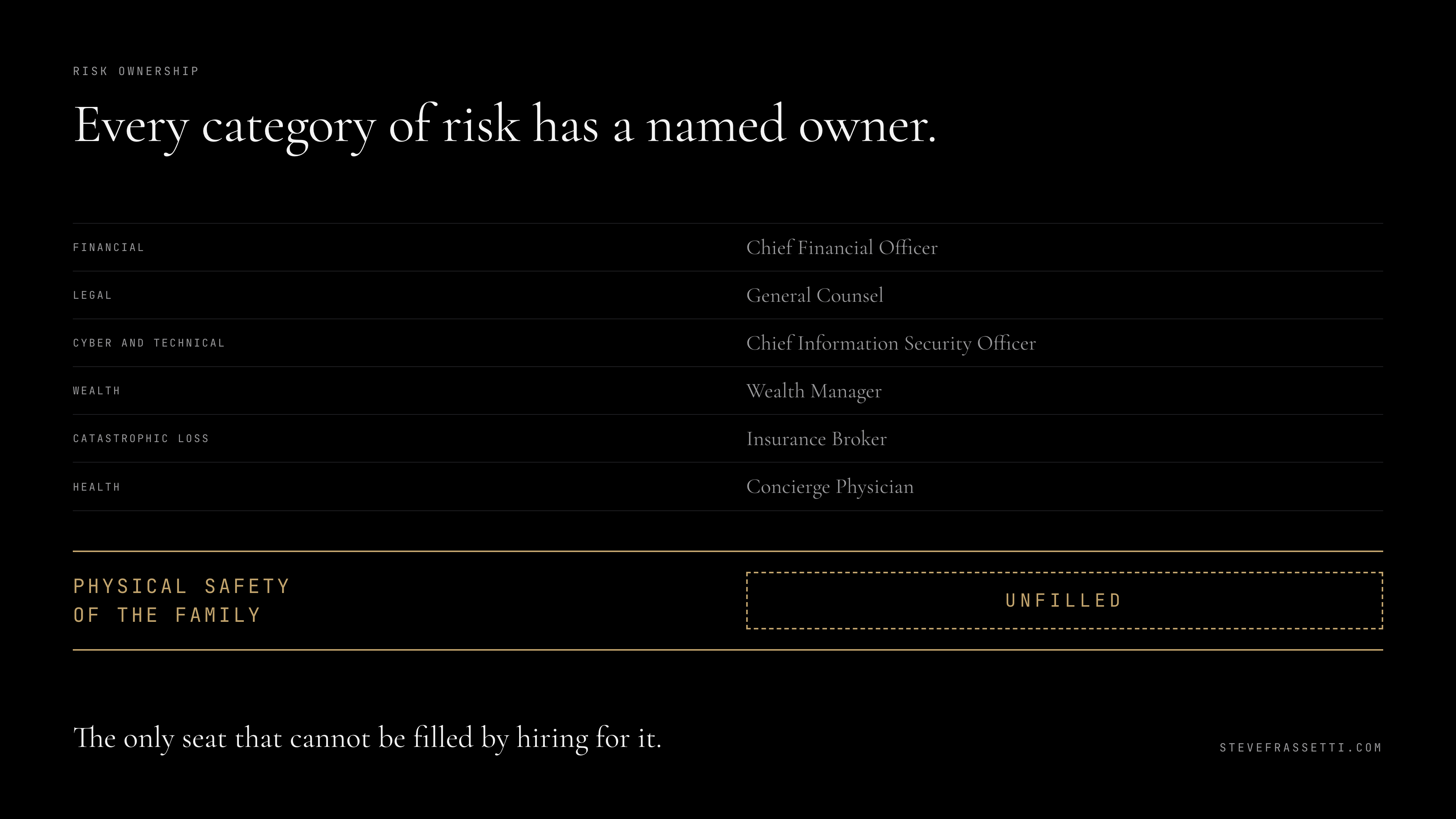
The Seat Was Never Filled, and It Was Never Empty by Decision
The seat is not empty because the executive judged it low priority. It is empty because it was never presented as a seat.
Nobody sends a calendar invite about it. No advisor raises it in a quarterly review, because it sits outside every advisor’s remit. The estate attorney plans for what happens after. The insurance broker prices the loss once it has occurred. The physician manages the body’s slow risks and not its sudden ones. All three are doing their jobs correctly, and none of them is looking at the parking structure at eleven at night.
So the category never got named, and an unnamed category never gets an owner. What happened instead is that the risk was handed to hope, quietly and by default. Hope is the one instrument this executive would refuse in any other seat on the chart. No board would accept it for financial exposure. No general counsel would accept it for litigation. It is accepted here only because nobody ever said out loud that a decision was being made.
The Chief Protection Officer is that empty seat. The argument of this essay is not that the executive should aspire to the role. It is that the executive already holds it, has held it since the day there was a family, and has not yet met its requirements.
Why the Seat Cannot Be Filled by Hiring
This is the point at which the reflex arrives, and it is a reasonable reflex from a person whose entire method is delegation. If the seat is empty, hire for it.
Some of it can be hired, and that part is real. Executive protection is a legitimate profession. A detail works, on a schedule, against a known itinerary, in a defined threat picture. For an executive with a public profile and a predictable movement pattern, it is a sound control and it should be bought.
What it does not cover is most of a life.
A detail does not cover the school run. It does not cover a marriage, a hotel corridor at six in the morning, a restaurant parking lot after a dinner that ran long, or the ninety seconds between a car door closing and a front door opening. It does not cover the ordinary movement of a family through ordinary places, which is where nearly all of the actual exposure lives. An itinerary can be protected. A life cannot be put on an itinerary.
The second control the reflex reaches for is emergency response, and response is arithmetic. It is measured in minutes. A physical confrontation is usually decided in seconds. The gap between those two numbers is not a service failure and it is not solvable by a better vendor. It is the shape of the problem. No one is coming to save you inside that gap, because the gap is defined as the interval before anyone can arrive.
This is what separates this seat from every other one on the chart. The controls that fill the other seats are purchased, and a purchased control can be acquired in the week it is needed. The control that fills this seat is built, and a built control either exists before the moment that tests it or it does not exist at all.
That is the whole argument in one line. This is the only role in an executive’s life that cannot be filled by hiring for it. It has to be trained for and taken.
What Taking the Seat Actually Requires
A role with no requirements is a title. The requirements here are the Five Dimension System, and they come in a specific order, and the order is not a matter of preference. It runs from what is used most often to what is used least, which is the reverse of how self-defense is usually sold.
Reading the Environment
The first requirement is Awareness, because no risk can be managed before it is seen.
This is not vigilance and it is not suspicion. Both of those are exhausting, and anything exhausting gets abandoned inside a month. Calibrated awareness is closer to what the same executive already does on entering a boardroom: reading the room, registering who is present, noticing what has changed since last time, and knowing where the door is without having thought about it.
The skill transfers directly. What is missing is that it has never been pointed at physical space. The executive who can read a negotiating table in four seconds walks through a parking garage processing nothing, because nobody ever suggested that the two were the same act.
Leaving Before It Starts
The second requirement is Avoidance, and it is the primary tool of the role rather than a lesser alternative to fighting.
Most of the job is not being there. The exit taken early is not a failure of nerve; it is the correct execution of the role, and it is what the overwhelming majority of the work looks like in practice. A person who owns this seat competently will use Avoidance hundreds of times and technique almost never.
The reason it gets treated as second-tier is that it is invisible. Nothing happened, so nothing is credited. The financial equivalent is a hedge that quietly did its job: unremarkable, and the reason the quarter was survivable.
Avoidance is also the requirement most improved by rehearsal rather than by knowledge. Knowing that a second exit exists is not the same as having used it. The executive who has already walked the alternate route out of a familiar building has converted a fact into a practiced option.
The Physical Entry Requirement
The third requirement is Physical Readiness, and it is where the role gets uncomfortable, because it cannot be delegated to an idea.
The standard is not competitive athleticism. It is functional and it is narrow. The body has to be able to do what the role asks of it under load: move quickly for a short distance, carry or move another person, control a position long enough for the situation to change, and hold composure while the heart rate is somewhere it is not used to being.
An executive who cannot do those things is an unqualified Chief Protection Officer who cannot execute. The plan is sound and the operator cannot run it. This is the requirement most likely to be quietly skipped, because it is the only one that takes months and cannot be acquired by reading.
Capability Under Real Resistance
The fourth requirement is Capability, and it comes fourth deliberately.
It comes fourth because it is the last resort rather than the first answer. Everything above it exists to make sure this requirement is never reached. When it is reached, though, nothing else substitutes for it, and the standard becomes unusually strict.
Capability means technique that has been tested against a person who was genuinely trying to stop it. Training that has never met resistance produces confidence rather than competence, and the difference between the two is invisible until the moment it matters, which is the worst possible time to discover it. The sources that hold up are the ones with a live component: grappling, wrestling, and striking practiced against resisting partners.
An executive is well equipped to evaluate this, because it is the same question asked of any vendor claim. What is the record, against whom, under what conditions. A claim that cannot answer that is not a capability claim.
The Exposure Is Specific
The fifth requirement closes the loop back to where the argument started. The role is not generic, and it cannot be executed from a generic curriculum.
Two executives with similar net worth can carry entirely different exposure. One travels internationally twice a month and is photographed at industry events. One is unknown outside a trade and drives the same route daily. One has teenage children with public social accounts. One has a spouse who runs a separate business with a separate profile. The categories of risk are shared. The actual exposure is not.
Owning this seat means knowing which specific risks belong to this specific family, in the same way that owning financial risk means knowing this balance sheet rather than balance sheets in general. A program that does not begin with that question is selling a curriculum, not filling a seat.
The Standard of Care, and the Review
Naming an owner is only half of how the other seats work. The other half is that each one carries a standard of care and gets reviewed on a cadence, and it is the review that separates a real control from an intention.
This seat has neither, in almost every case where it has been taken. An executive decides the category matters, trains for a while, and then the training becomes an unexamined habit or quietly stops. Training is a perishable skill and nothing checks it. Compare that to how the same person treats the financial seat, where the standard is written down and the review happens whether or not anything has gone wrong.
The standard of care for this role is not complicated, and it follows directly from the requirements. Awareness is met when reading a physical environment happens without deliberate effort, which is a thing a person can honestly assess about themselves. Avoidance is met when alternate exits have been used rather than noted. Physical Readiness is met against the specific tasks the role asks for, not against a general fitness standard. Capability is met when technique has been tested against genuine resistance recently enough to still be true. Context is met when the exposure has been written down and matches the family as it is now rather than as it was three years ago.
The review is the part that gets skipped, and it is the cheapest part. Exposure changes without announcing itself. A child starts driving. A spouse takes a public role. A company announces something that puts a name in a trade publication for the first time. A house move changes every route. Each of those alters the risk picture, and none of them arrives labelled as a security event.
Every other risk on the chart gets looked at on a schedule precisely because the person who owns it knows that conditions drift faster than attention does. This seat is not different. It has simply never had anyone whose job it was to put the review on the calendar.
What Changes When the Seat Is Taken
Very little changes visibly, which is the point.
The executive who has taken this seat does not become a different person, does not carry themselves differently in a lobby, and does not talk about it. What changes is that a category of risk that was being carried by hope is now being carried deliberately, by someone competent, with the requirements met in order.
The role was always occupied. The only question was whether it was occupied by someone who had accepted it.
Every other seat on that chart got filled because someone named the risk and then found the person accountable for it. This one has been named now. The person accountable for it has been on the chart the entire time.
The First Step Is an Assessment, Not a Commitment
Every engagement Steve Frassetti takes on begins with a Discovery Call: thirty minutes, no obligation, an evaluation of the specific exposure in question and whether the system fits it. It is how any other risk on the chart would be handled. The current state gets established before anything is prescribed.